
A Challenge Even For the “Handwriting Experts.”
Handwriting difficulties are the most common reason for referral to school-based occupational therapy (OT).
However, even moat school-based therapists question how to provide effective and appropriate support for written expression difficulties in students with ADHD. The most frequently asked questions I hear from other therapists are most likely ones you may have asked yourself many times.
“What do we do with the kids with ADHD who, when you evaluate, test in the average ranges for fine and visual motor skills, BUT in the classroom, they are falling apart?”
“My students with ADHD who can write for me in our sessions but the skills don’t carry over into the classroom.?
“My student demonstrated age-appropriate skills last year but now their writing is totally illegible? .”

Even the “ experts” need a better understanding of the complexity of the writing process for students with ADHD.
ADHD’s Impact on Handwriting and Written Expression
High-quality writing depends on handwriting , spelling, working memory, and executive function, which are often challenging for children with ADHD.
Evidence supports that children with ADHD often have specific difficulties in written expression that include :

- Poor overall legibility
- Poor organization of written material
- Poor spacing within and between words
- Inconsistent letter size and shape
- Frequent erasures
- Pressured writing
- Difficulty spelling
- Lack of capitals and punctuation
- Frequent omissions of letters or words
- Problems organizing thoughts, prioritizing, and sequencing
The “Anything But Simple View of Writing”
Written language is a complex skill that integrates multiple components, each with its developmental sequence. Berninger et al. 2006 refer to handwriting as “language by hand.”
Handwriting is not just a motor skill; as illustrated in The “Simple View of Writing” Model (Beringer et al. 2006) pictured here.
Writing is a complex process that requires the integration of :
- transcription skills ( handwriting, spelling) and
- executive function skills ( planning, organization, and self-regulation)
- to enable text generation (outcome as words, sentences, composition ).

Berninger et al. 2006 emphasizes that all processes are guided and constrained by working memory. Unfortunately, working memory is a limited resource and an area of significant weakness in children with ADHD.
The more working memory resources required for any individual component of the writing process, the fewer resources are available to manage other elements of writing process.
Students with age-appropriate fine and visual motor skills can produce short legible copy samples but will have difficulty with generalization into the classroom due to working memory deficits. A student who needs to actively think about how to form a letter or spell a word will use up the limited working memory space that is needed to hold the thought they are writing.
Kids need to be able to write letters and spell words without thinking too hard about it. When handwriting and spelling become automatic, it frees up their brain to focus on what they actually want to say.
Poor Automaticity in Handwriting
Working memory plays a big role in helping students develop automatic handwriting. Most kids, with enough practice, start to form letters without thinking much about it. This ” automaticity” frees up their brain to focus on what they’re writing.
But for students with ADHD and other neurodevelopmental differences, it’s not that simple. They often have delays in the basic visual, motor, and sensory skills needed to build those automatic writing habits. That’s why they might be able to write single letters or short words clearly, but still struggle when trying to write full sentences or express their thoughts on paper.
But for students with ADHD and other neurodevelopmental differences, it’s not that simple. They often have delays in the basic visual, motor, and sensory skills needed to build those automatic writing habits. That’s why they might be able to write single letters or short words clearly, but still struggle when trying to write full sentences or express their thoughts on paper.

Their working memory gets overwhelmed, and it’s just too much to hold in their head at once.
Poor Automaticy in Spelling Skills
SSpelling puts even more pressure on working memory. Students with ADHD often make a specific type of spelling mistake called “graphemic buffer errors.”
The graphemic buffer is like a mental whiteboard that holds the letters of a word in order in your head while you write them down. If this system doesn’t work well, it’s hard to remember what letters come next leading to errors in letter sequence and omissions.

Without strong spelling skills or automaticity, students often pause, hesitate, and write more slowly, making writing feel even harder.
So “What do we do with this ever-increasing population of ADHD students who are not writing?”
Regardless of the age, stage, and co-occurring condition, the most effective evidence-based strategies to improve performance in written expression is to support and reduce working memory demands needed for the writing task. This allows the learner to dedicate more working memory resources for text production.
Students with ADHD need support where they are currently, in the point of performance, in the classroom.
Using the restorative model alone to improve the underlying performance components needed for handwriting is not supported by evidence to effectively improve handwriting. Therapists require interventions to use within the classroom context.

The following evidenced-based interventions will improve occupational performance in the classroom by supporting working memory, scaffolding executive functions and promoting automaticity of handwriting skills.
Evidenced Based Handwriting Interventions for Students with ADHD
Integrated Therapy At the Point of Performance
Support in and with actual classroom assignments. Many classrooms have “morning work” or ” writers journal” time where the OT will be able to intervene at the point of performance .
Reduce Environmental Distractions
- Reduce distractions or friction to decrease the external processing requirements during the writing task.
- Consider how much more working memory is required for far point copying than near point. Sticky notes are gold here.
- I have used a wipe off marker and just written right on the students desk. The “pure insanity” of that maneuver was the just right engagement factor needed to get that student going. (hand sanitizer cleans it off) .

Use Procedural Feedback:
Monitor and provide feedback for the process, not the product, and prevents incorrect repetitive practice. Provide models in between letters. Have the student write one line of text and then check before going on. Prevent having the student with ADHD to have to ” redo” large amounts of work by providing frequent monitoring.
Facilitate Frequent Self Evaluation:
Circle the best-formed letter on that line, provide a self-check rubric, so the student can stop and monitor and self-correct
Circle the best-formed letter on that line, provide a self-check rubric, so the student can stop and monitor and self-correct

Adapt Writing Materials:
The therapist can bring in select paper and writing materials that reduce working memory load.
Papers can contain externalized working memory supports, explicit visual supports, directions, increased space for writing, color for engagement, and less visual information on the page.
Using just a green, blue and brown colored pencil or a highlighter can make a dramatic difference for the learner.

Reduce Perceived Workload /Quantity
Therapist can reduces demands on working memory and other EF skills by reducing the “perceived” work load.
- Using graphic organizers
- Present only one part of the writing task at a time will reduce the perceived work load .
- You can fold the assignment in half.
- Cover it with another sheet or use a chunking folder.
- I use a ” to do list” wipe off sheet and list the parts of the assignment for them , going as detailed as the student needs.
Whole class or small group supports can be added to the classroom program or small group instruction.
Use Explicit Scaffolded Instruction– Use explicit handwriting instruction with scaffolds geared towards automaticity.
- Can you write this letter with your eyes shut?
Gradual Faded Visual Prompts – provide all the external boundaries needed for immediate success, then gradually fade visual boundaries.
- Give the students a visual starting point .
- Use enlarged or colored baseline.
- Provide size and height boundaries with box dot prompts.
.

Use Video Modeling– video models help create motor engrams of letter formation sequences. They use verbal and visual supports simultaneously and allow the teacher to provide procedural feedback for students as they write.

Structured Instruction Sequence– sequence of letters should be grouped by similarities to strengthen motor engram development.

Top Ten Tools for Integrated OT Sessions
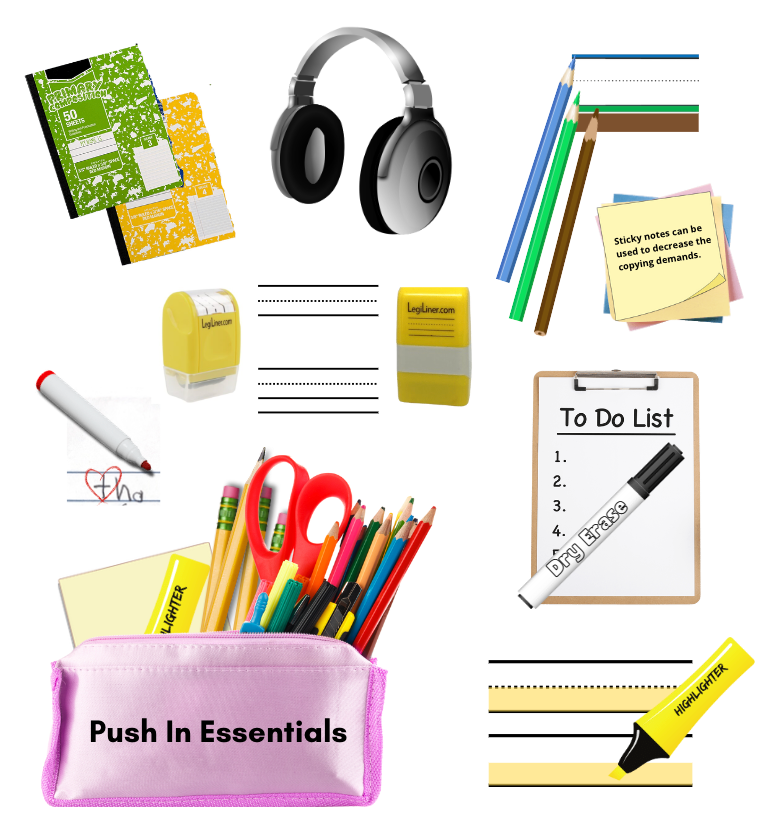
There are so many available resources to put in your “push in” bag. These are always in mine and used every day. Some include affiliate links and discounts for purchasing.
- Blue/Green/Brown colored pencils to shade writing areas. Colored pencil accept pencil writing better than markers or crayons.
- Highlighters
- Legiliner and Legiliner Worm Line
- Alternate Ruled Notebooks Grade 3 /Alternate Rule Notebook Grade 4
- Post Its
- To Do List Wipe Off Board (Visual Schedule)
- SHARP PENCILS with erasers: (don’t even get me started on the dull pencil problem )
- Sound Blocking Headphones– Amazon has affordable pairs
- Love pen – This is just a red marker or pen that I “heart” letters or words or lines with. I also encourage students to find and heart their own.
- Wipe off marker.
Click here for a 15% off coupon for Legi-liner.
Key Takeaway
Written expression is the complex process that is governed and managed by working memory, an area of significant weakness in children with ADHD.
Contrary to limiting beliefs, our scope is not limited to just the motor components of school based occupations.
School-based therapists can provide effective and appropriate support for written expression difficulties in students with ADHD who score age appropriate in “fine and visual motor skills”. We need to work in the classrooms to promote generalization of skills and provide ongoing support to these kids because as the writing demands increase from word, to sentence to paragraph, so do the demands on executive functions.
Providing a variety of working memory supports in the classroom will improve occupational performance in written expression for students with ADHD. Reducing differentiation demands upon the classroom teacher is always a welcomed relief for your colleague. 😉

Download this free one-page PDF to help explain to teachers and parents why your students are having difficulty with written expression and what to do to support it.
To dive deeper explore our newest resource, It’s Not Just Handwriting. The on demand course and resource printable bundle gives you actionable, differentiated strategies to reduce executive function barriers that commonly interfere with BOTH learning to write and using writing to demonstrate learning for students across K-12.

References
- Rebecca A. Langmaid, Nicole Papadopoulos, Beth P. Johnson, James G. Phillips, Nicole J. Rinehart. Handwriting in Children With ADHD. Journal of Attention Disorders. https://doi.org/10.1177/1087054711434154. Original Research.
- Berninger, V. W. (1999). Coordinating transcription and text generation in working memory during composing: Automatic and constructive processes. Learning Disability Quarterly, 22(2), 99-112.https://doi.org/10.1007/s11881-011-0054-0
- Agnese Capodieci, Simona Lachina, Cesare Cornoldi,Handwriting difficulties in children with attention deficit hyperactivity disorder (ADHD),Research in Developmental Disabilities,Volume 74,2018, Pages 41-49, ISSN 0891-4222, https://doi.org/10.1016/j.ridd.2018.01.003. (https://www.sciencedirect.com/science/article/pii/S089142221830009X)
- Kaiser ML, Schoemaker MM, Albaret JM, Geuze RH. What is the evidence of impaired motor skills and motor control among children with attention deficit hyperactivity disorder (ADHD)? Systematic review of the literature. Res Dev Disabil. 2015 Jan;36C:338-357. doi: 10.1016/j.ridd.2014.09.023. Epub 2014 Nov 6. PMID: 25462494.
- Liat Hen-Herbst; Handwriting Measures and Executive Functions Among Adolescents Referred to OT. Am J Occup Ther August 2021, Vol. 75(Supplement_2), 7512505220p1. Doi: https://doi.org/10.5014/ajot.2021.75S2-RP220
- Berninger V. W., Lee Y. L., Abbott R. D., & Breznitz Z. (2013). Teaching children with dyslexia to spell in a reading-writers’ workshop. Annals of Dyslexia, 63, 1–24. https://doi.org/10.1007/s11881-011-0054-0 [Google Scholar]
- Marie Brossard-Racine, Michael Shevell, Laurie Snider, Stacey Ageronioti Bélanger, Marilyse Julien, Annette Majnemer. Persistent Handwriting Difficulties in Children With ADHD After Treatment With Stimulant Medication. Journal of Attention Disorders. https://doi.org/10.1177/1087054712461936. Original Research
- Javier Fenollar-Cortes, Ana Gallego-Martinez, Luis J. Fuentes. The Role of Inattention and Hyperactivity/Impulsivity in the Fine Motor Coordination in Children with ADHD. Research in Developmental Disabilities. https://doi.org/10.1016/j.ridd.2017.08.003. Original Research.
- https://sites.nd.edu/biomechanics-in-the-wild/2021/04/07/attention-deficit-handwriting-details-the-effects-of-adhd-on-handwriting/Source: Handwriting Performance in Children With Attention Deficit Hyperactivity Disorder (ADHD) – Marie Brossard Racine, Annette Majnemer, Michael Shevell, Laurie Snider, 2008
- Agnese Capodieci, Simona Lachina, Cesare Cornoldi,Handwriting difficulties in children with attention deficit hyperactivity disorder (ADHD),Research in Developmental Disabilities,Volume 74,2018, Pages 41-49, ISSN 0891-4222, https://doi.org/10.1016/j.ridd.2018.01.003. (https://www.sciencedirect.com/science/article/pii/S089142221830009X)
- Mayes SD, Breaux RP, Calhoun SL, Frye SS. High Prevalence of Dysgraphia in Elementary Through High School Students With ADHD and Autism. Journal of Attention Disorders. 2019;23(8):787-796. doi:10.1177/1087054717720721